What's holding Meta Stock back? I have a weird take...
Meta just released incredibly strong Q1'26 earnings results.
- Revenue was up a whopping 33% YoY to $56.31B
- Operating income up 30% to $22.87B.
- Ad impressions across the Family of Apps grew 19% YoY, while average price per ad grew 12% YoY. Usually there's an inverse relationship between the two: when impressions go up, prices tend to fall (more inventory, less scarcity), and vice versa. But when both go up at the same time, you get a burst of revenue, which is exactly what happened this quarter.
- Family of Apps Daily Active People (DAP) dipped quarter-on-quarter, which management attributed to internet disruptions in Iran and a restriction on access to WhatsApp in Russia. And yet, Family Average Revenue per Person still climbed to $15.66 vs $12.40 a year ago (see chart below). That means even with absolute user growth slowing, Meta is somehow squeezing more value out of each user through better engagement and ad efficiency.
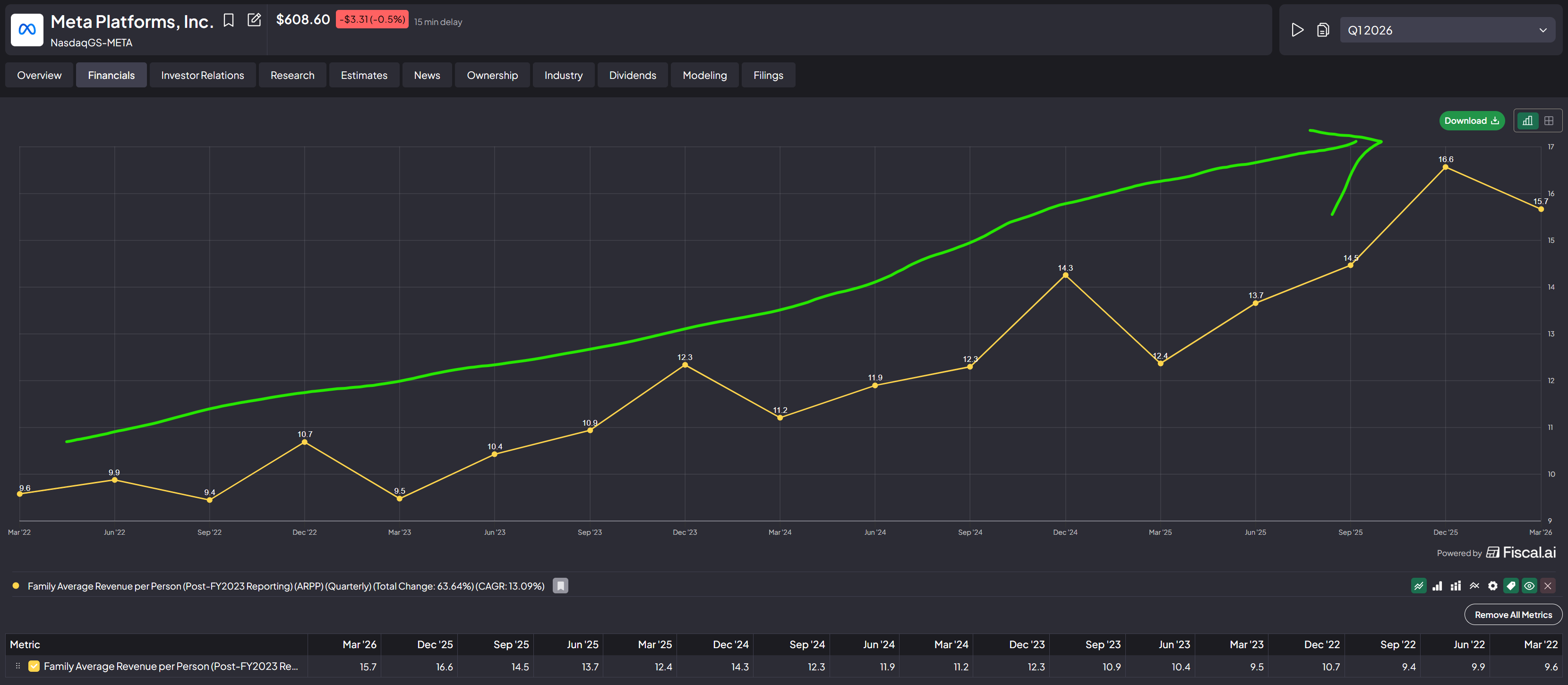
In fact, per eMarketer's April 2026 forecast, Meta is on track to dethrone Google as the world's largest digital ad platform this year for the first time, with $243.46B in projected net worldwide ad revenues vs Google's $239.54B.
For a company at this scale (~$215B LTM revenue), the mentioned growth rates are unheard of and Meta's forward trajectory looks to be very strong, but yet, the stock still fell ~10% post-earnings. After watching the call and digging through the report, I think I've figured out why.
So why did the stock still fall ~10%?
The obvious culprit is the capex raise. Meta bumped its 2026 capex guide by $10B, to $125-145B, citing higher component pricing and data center build-out. Fair concern on its own. But here's where it gets weird.
The same week, Google reported and ALSO raised capex (by $5B, to $180-190B). And Google's stock went UP ~10% the next trading day. Two ad businesses, both raising capex aggressively for AI, but completely opposite reactions by the market. Why?
I believe the market scored each by visibility of return. Google could point to a Cloud backlog that nearly doubled quarter-on-quarter to over $462B, Cloud revenue growing 63% YoY, and a clean story about selling AI enterprise compute and TPUs to third parties. That's contractual, chartable and easy to visualize to wall street analysts in terms of AI ROI. Meta has no equivalent, because Meta IS the 1st party AI customer here, not the AI vendor and so does not invest with a plan of "visibly selling AI compute to another party".
The single best illustration of this gap was the awkward exchange between an analyst and Zuckerberg on the call:
Analyst:
Mark, I wanted to ask you just about the level of investment you're making and sort of the signposts you're watching to ensure you're going to generate ROIC on all these investments behind Muse and the other products. So if you could just sort of let us know some of the key factors you're watching over the next 12 to 24 months...?
Zuck:
...The formula for our company has always been build experiences that can get to billions of people and focus on monetizing them once you get to scale. That's, we're seeing a little bit of that here where basically we invest in advance to build leading models, and we convert that into leading products. And then we think that these are going to be some of the most important products that get built over the next decade.... I don't, I mean like I don't think we have a very precise plan for exactly how each product is going to scale month-over-month or anything like that.... I think for the kind of specific financial questions, I think Susan can jump in if there's anything more to add.
That last line was followed by an awkward 5-second pause where neither Susan Li nor Zuck offered a specific short-to-medium-term ROIC framework for these investments. You can hear the awkward silence for yourself starting at 35:19 here: https://www.youtube.com/live/e4k-XDaUfSo?si=itwvdrq_a2cblUSl&t=2119.
My weird take
Here's the thing analysts keep missing. Every other big AI company at this scale (Amazon, Microsoft, Google) is fundamentally selling AI compute to third-party enterprises. Each new contract with the frontier labs (OpenAI, Anthropic, xAI, etc.) becomes a multi-billion-dollar press release that invites a lot of limelight. Meta on the other hand, doesn't have this. Meta targets the consumer, builds its own frontier models, and monetizes through its existing ad business at a similarly massive scale.
So Meta's "line of sight ROI" doesn't arrive in chunky contract announcements. It compounds less visibly, inside its own P&L, quarter after quarter, in the form of higher engagement, better ad targeting, and higher revenue per user.
And that's exactly what's happening. From this most recent earnings call, Meta's AI investments are already delivering measurable returns:
- "On Instagram, the ranking improvements that we made in Q1 drove a 10% lift in Reels time spent"
- "In Q1, enhancements we made to Lattice's modeling and learning techniques, along with advances in our GEM model architecture, drove a more than 6% increase in conversion rate for landing page view ads"
- "Usage of our ad creative tools is also scaling with more than 8 million advertisers using at least one of our Gen AI ad creative tools, and particularly strong adoption among small- and medium-sized advertisers" (this has doubled from 4 million in just 15 months!)
- And many more...
These aren't future contractual obligations (which may or may not be fulfilled btw!). They are numbers that are shipping today, and they show up directly in the 19% impression growth, 12% higher ad prices, and +33% revenue we just talked about above.
One might even argue that, Meta has higher quality of earnings than the circular hyperscaler RPOs (Remaining Performance Obligations) that Wall Street loves. Frontier labs (OpenAI, Anthropic, etc.) are funded in part by hyperscaler equity stakes, and they recycle that cash right back as cloud spend, which then shows up as backlog/RPO growth, which then justifies further hyperscaler capex. Meta's AI ROI doesn't depend on that loop. It comes from advertisers happily paying Meta more per ad because Meta's AI makes the ads convert better.
While Wall Street can appreciate contract announcements, it can't easily chart compounding ad efficiency.
Issue isn't fundamentals, it's framing!
And so, I believe the thing holding back Meta's stock right now is a question of PR and narrative, not the underlying business - case in point, the awkward 5-second silence on the call.
In the past, every Meta earnings call had a fixed three-voice structure: Zuck on vision and product, Sandberg on the ads business and the CFO on financial guidance. When Sandberg left in 2022, the ads-business-narrator role wasn't really replaced.
Today, it's Zuck plus Susan Li, with no one between them whose job is to tell the AI + Ads ROI growth story to investors, translating Mark's long-term product vision into a clean, investor-friendly business narrative that Wall Street could chart in the short-medium term, justifying AI capex investments. Until Meta plugs that comms gap, I believe analysts will continue to fixate on the long-term-vague language Zuck likes (Superintelligence, personal AI agents, self-improving models, etc.) instead of the very real ROI already showing up in the revenue and profit numbers.
Zuck's style of product/tech speak resonates with people in tech (like myself), but unfortunately, it doesn't resonate well with Wall Street analysts.
One more underrated angle: margins
Worth flagging that from a pure margin standpoint, Meta's business model is still arguably the best of all the hyperscalers. Advertising is incredibly high-margin, and Meta doesn't carry the GCP-style infrastructure-as-a-service drag that compresses Google's consolidated margins. So when the AI capex eventually rolls off into the depreciation schedule and the ad efficiency gains keep compounding, Meta's flow-through margin economics should look better than what we're seeing at any of the other hyperscalers, not worse.
My thesis
My long-term thesis on Meta remains intact. The market is currently mispricing the gap between Zuck's mid-to-long-term vision (build frontier AI products, scale them with product-market fit, monetize through the existing ads engine, the exact playbook he ran with Facebook, Instagram, WhatsApp, and now Threads) and what's already showing up in the numbers today. That gap is alpha that is yet to be fully captured.
All Zuckerberg and management really needs is the right framing or let the numbers do the talking over time, making the stock even more irresistable than it already is.
Below, I share my updated valuation buy levels for META, plus other names on my watchlist that released earnings this week.
My Next Investment Steps & Valuation buy levels:
Note: The following does not constitute financial advice/recommendation and is merely a journal of my own portfolio investment actions.
See below: (🔒Unlock with premium tier):
Portfolio allocations (in USD) and my valuation watchlist buy levels are as follows...