I Just Committed $150,000 Into This Stock. Why I was wrong about Enterprise AI
Disclaimer: Not a recommendation or advice to buy/sell any of the below-mentioned stock/s. This article documents my own investment thesis and portfolio actions.
A few months ago, I wrote an article explaining why I was skeptical that enterprise AI would generate attractive returns on the enormous amount of capex being deployed into it. In short, I believed that the hallucination rate of LLMs would make them unsuitable for large parts of enterprise work, where certainty matters far more than the average consumer use case.
I now believe I got that conclusion wrong.
What changed my mind
I first started coding with GPT and Claude around 2-3 years ago. Back then, I constantly found myself trapped in loops. The AI would build something, encounter an error, attempt to fix it, create another problem, and eventually reach a point of an inescapable infinite loop.
That experience, together with the hallucinations I regularly encountered using earlier versions of ChatGPT and Claude, seeded the idea in my head that next-token prediction (the way LLMs work) would eventually hit a ceiling in the enterprise space.
What I underestimated was how much the entire system around the base model would continue to improve through better training data, post-training, reinforcement learning, longer context windows, better harnesses and increasingly capable agentic tool use.
For me, the turning point was Claude Opus 4.8, released on 28 May 2026. That was the first model where I felt a surprisingly large variety of enterprise work could be completed at a level comparable to a competent knowledge worker, despite hallucinations still technically existing. More importantly, I was no longer constantly getting stuck in loops and could actually finish complex tasks end-to-end.
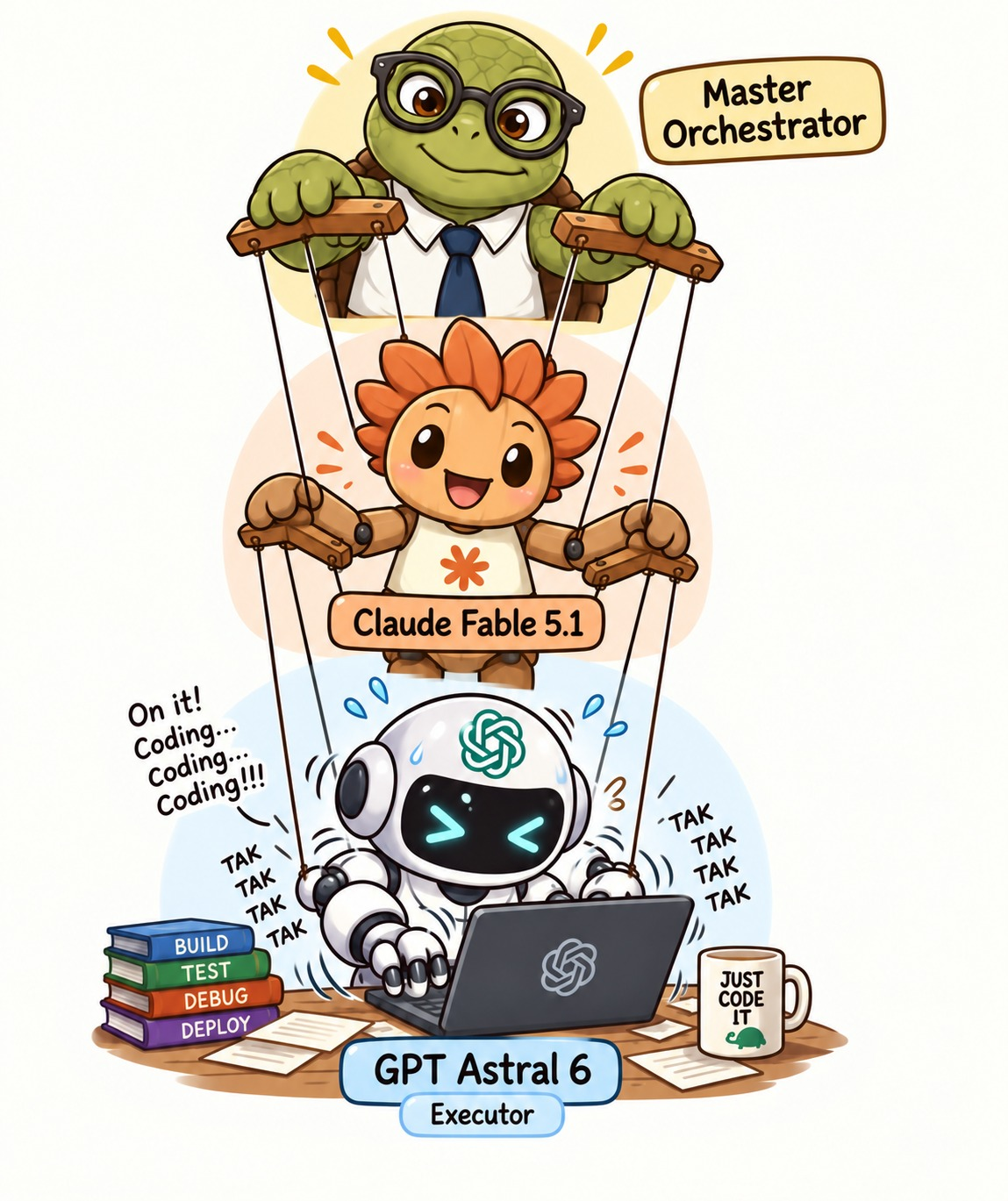
Over the past month, I tested this firsthand by coding extensively, using Claude Code Fable 5 as orchestrator, with GPT Sol and Astra as executor. I was able to vibe code an entire app into production merely by chatting with AI, shipping Palabud, a food app I built to disrupt the traditional Michelin Guide/ World's 50 best Restaurant leaderboard model.
...Shameless plug: If you're a hardcore foodie, do check out my app and follow me at @turtle_eats. Over 30 users have already joined since I launched a few days ago. The more people we have on the network, the more useful it becomes to us foodies...
The newest frontier models also seem to have developed surprisingly good "taste". I can now discuss architecture, user experience, database design, bugs or UI decisions with the model and increasingly feel like I am working with a seasoned product manager, software engineer and designer sitting beside me.
A task that may previously have taken weeks can sometimes be compressed into a day. This productivity increase, alongside an expansion of agentic capabilities and reduced hallucination are what completely changed my view of enterprise AI.
Why Enterprise AI's potential is enormous
I used to think consumer AI would have the cleaner near-term monetisation opportunity. I now think enterprise AI could drive a disproportionate share of incremental inference consumption over the next few years.
The key reason is agency.
People inside companies are paid to accomplish something. A developer needs to ship code. An analyst needs to finish a financial report. A salesperson needs to research an account. A consultant needs to build a deck. A marketer needs to analyse a campaign.
Because there is an economic objective at the end of the task, and often someone's career performance attached to it, power users will keep prompting, iterating, calling tools and running agents until the work is complete, consuming a tremendous amount of inference compute in the process.
That is very different from consumer AI today where the concentration of power users is far less and incentives are different.
For mass-market consumer AI, I think we still need much more fully formed products that handle the complexity of prompting and orchestration for the user. In enterprise, the incentive to learn how to use these systems properly already exists because doing so can dramatically increase one's productivity.
I am seeing this firsthand at work as well. Colleagues across both my previous and current jobs are using AI to research questions, analyse information, draft reports, classify data and even prepare entire presentation decks after the AI reads meeting transcripts and related documents.
The use case is clearly not confined to coding alone.
We can see a similar breadth in OpenRouter's share of spending by tasks below.
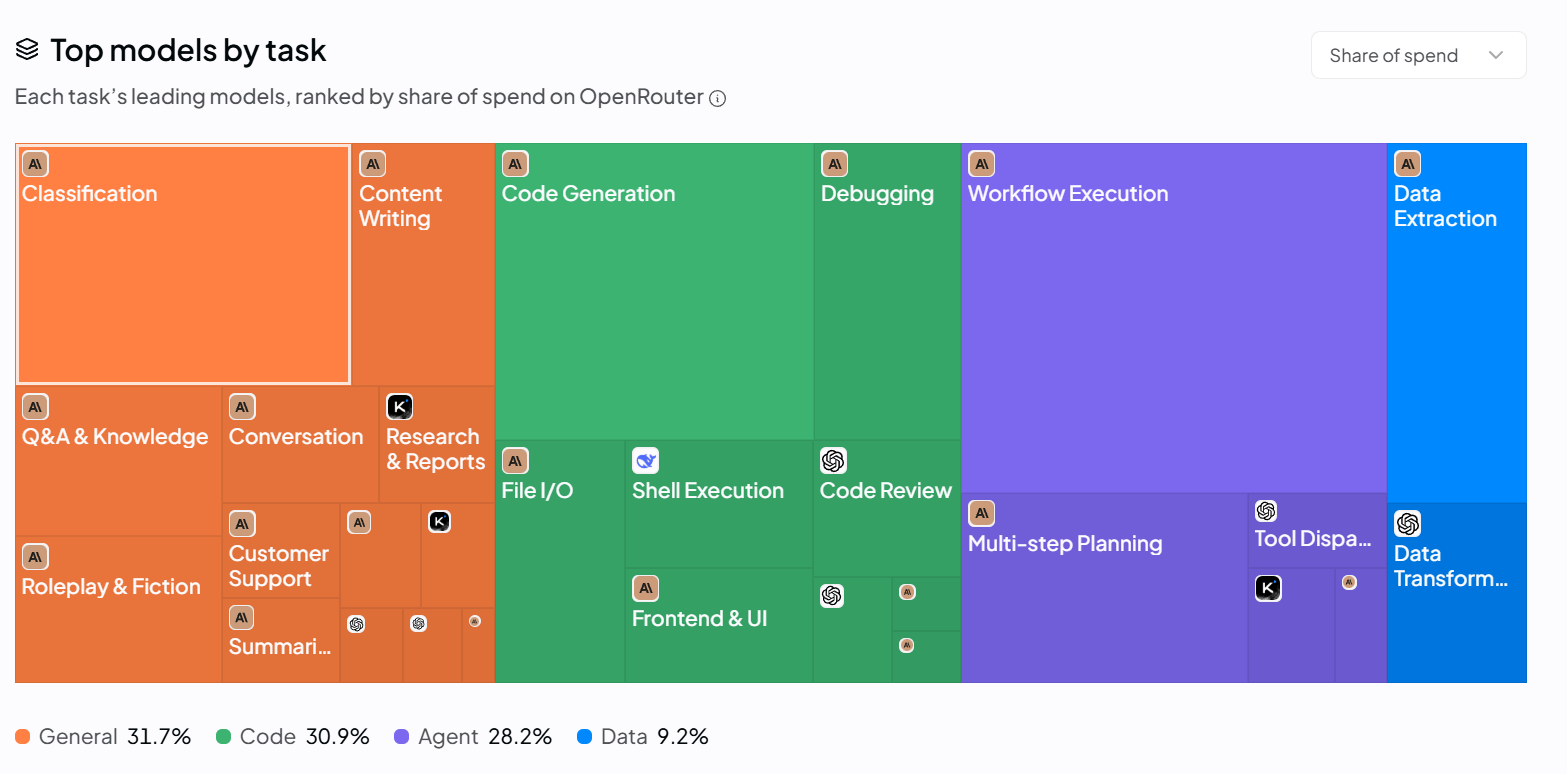
OpenRouter obviously represents only traffic going through OpenRouter, not the entire AI market. But I think it provides a useful proxy into how broad real-world model consumption is becoming.
Which companies will benefit the most from Enterprise AI?
On 29 June 2026, Rihard Jarc wrote this article entitled "Why Token Optimization Is a Gift to the Hyperscalers" which convinced me on the concept of owning an AI tollbooth.
The basic argument is simple. Businesses will increasingly stop using the most expensive frontier model for every task. As cheaper models improve through better training, distillation, post-training and architectural advances, an increasing amount of routine inference can be routed away from frontier models.
I believe that the majority of enterprise inference will eventually be handled by cheaper models that simply clear the intelligence threshold required for the task.
This is precisely how I built Palabud - I used the frontier Fable model for the hardest work such as planning, architecture and orchestration, then routed more mechanical coding towards cheaper models like GPT Sol, Astra and Claude Opus.
I see the same cost optimisation beginning to happen inside enterprises. At my current workplace, default model settings are already increasingly designed around cost rather than maximum intelligence. In my previous workplace, which was one of the more AI-forward enterprises I have worked at, management was similarly beginning to limit expensive frontier-model usage while encouraging employees to use cheaper alternatives for simpler tasks.
This is exactly what Rihard calls the shift from token maxing to token optimisation.
At first glance, this sounds bad for cloud providers. If every individual token keeps getting cheaper, surely everybody makes less money?
I think the opposite may happen.
Whichever model serves the request still needs to run somewhere. The enterprise still needs compute, databases, storage, networking, memory, security, observability and an environment for agents to execute tools.
Someone also needs to orchestrate the whole thing, deciding which model handles which task, managing agent state, routing requests and connecting the models to enterprise systems.
That is where hyperscalers like Amazon, Microsoft and Google increasingly become the AI tollbooths.
As model costs fall, Jevons paradox kicks in. Cheaper inference makes it economical to run more agents, for longer periods, across more tasks. A company may spend less per token but consume vastly more tokens overall. Rihard makes the same argument, noting that cheaper models enable companies to let agents run loops, read entire codebases and repeat tasks that previously would have been too expensive.
The model layer may commoditise but the infrastructural hyperscaler layer underneath it still gets paid.
Why I have chosen this specific company to deploy $150,000 into
Out of the three hyperscalers, I believe Amazon has the strongest overall position in enterprise AI. This is why some of the transactions I've recently made here have culminated in ~$150,000 invested in Amazon.
Here are my reasons, ranked roughly in order of importance,
- Custom ASICs
Owning in-house custom silicon gives hyperscalers a structural cost advantage in inference. Instead of buying every unit of compute from Nvidia, hyperscalers can increasingly shift large, predictable workloads onto ASICs designed around their own infrastructure, bypassing some of the economics embedded in Nvidia's 70%+ gross margins.
At sufficient scale, some of those savings can then be passed on to customers through lower inference prices, creating the kind of flywheel Nick Sleep described as "Scale Economies Shared": lower costs drive lower prices, which stimulate yet greater usage and further improve economies of scale.
Nvidia still has major advantages in general-purpose performance at the frontier, particularly with CUDA's software ecosystem. But hyperscalers do not need their custom chips to beat Nvidia across every benchmark. They simply need sufficiently good performance at a materially lower cost per useful token for workloads they can predict.
Out of the 3 hyperscalers, only 2 have a mature ASICs program:
- Amazon with Trainium (3rd generation)
- Google with Tensor Processing Units (8th generation)
Here you might be scratching your head and wondering, well, it sounds like Google has the edge here.
Indeed, if we look at it solely from a custom silicon and 1st party model (Gemini) perspective, Google is ahead of AWS with an integrated approach. But as we start to look into a broader set of criteria, this comparison gets a bit more nuanced than it seems.
In the next section, I cover:
- 2 remaining reasons why I prefer Amazon's position in Enterprise AI (🔒premium tier)
- Latest Portfolio allocation and Next Buy Plan (🔒premium tier)
One key reason I decided to focus on Amazon over Google is...