AI Can't Break This Stock. A Contrarian Investment.
Note: This article was inspired by Thomas Chua's Article, do check it out!
On 17th Nov 2025, Google released AI Trip planning, sending a particular stock down -10%.
Then on 30th Jan, Claude Cowork released plugins, crashing the stock by another 25%.
More recently, the Citrini report sent the stock down another 5% in a single day.
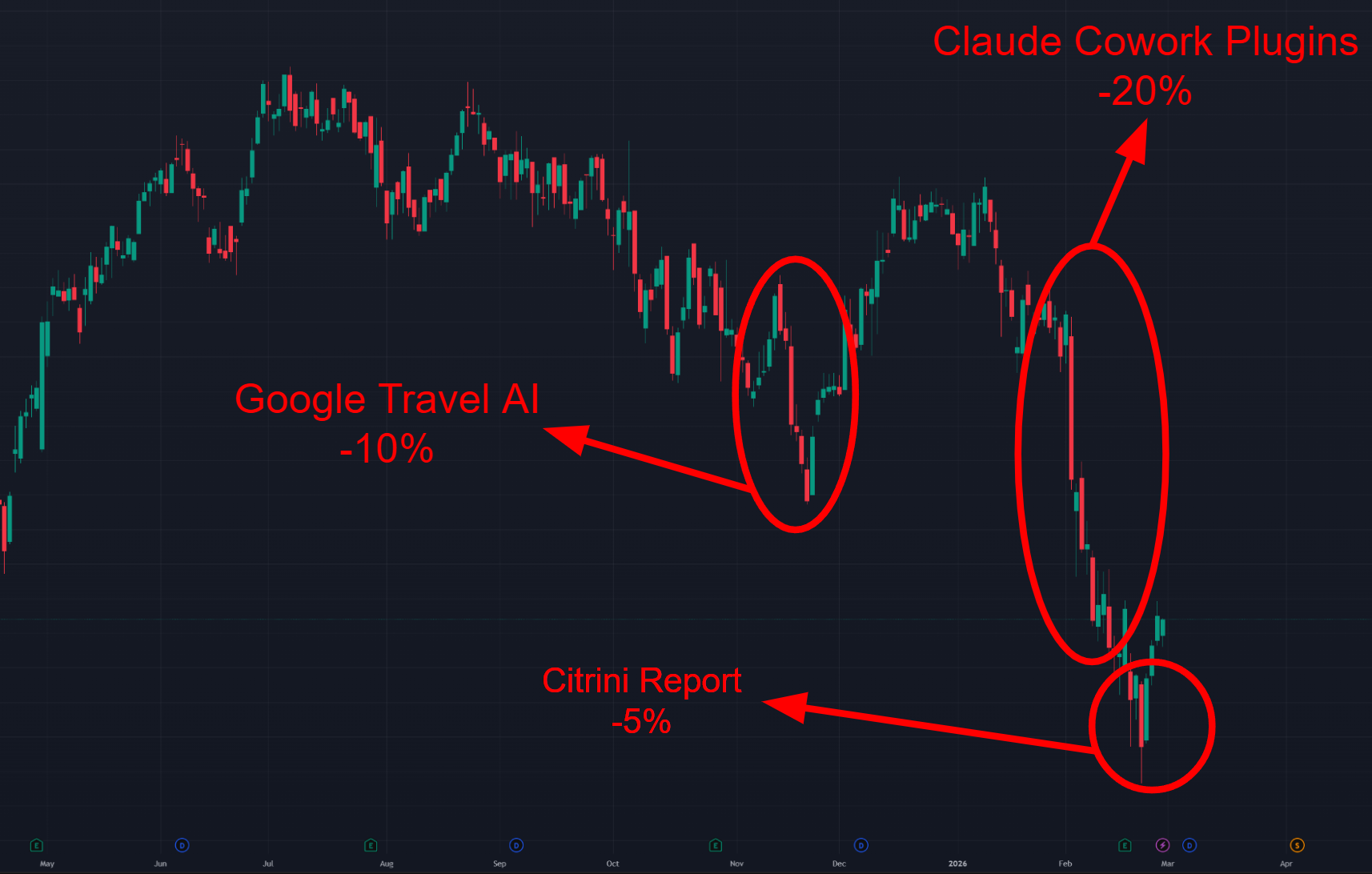
After 8 months of negative AI news, the company currently sits at ~30% below its 52 week high and is creating an interesting opportunity.
This stock, is none other than the world's largest travel company,
Booking.com ($BKNG)
In this article, I cover:
- $BKNG's Business model
- The Travel Stack and AI Disruption
- My Next Investment Steps and Valuation Buy Levels (🔒Unlock with premium tier)
Business Model
$BKNG is the world's largest online travel aggregator. If you've ever travelled around Europe or Asia, chances are you've booked a hotel on one of the company's websites, whether that's booking.com, agoda.com, or priceline.com.
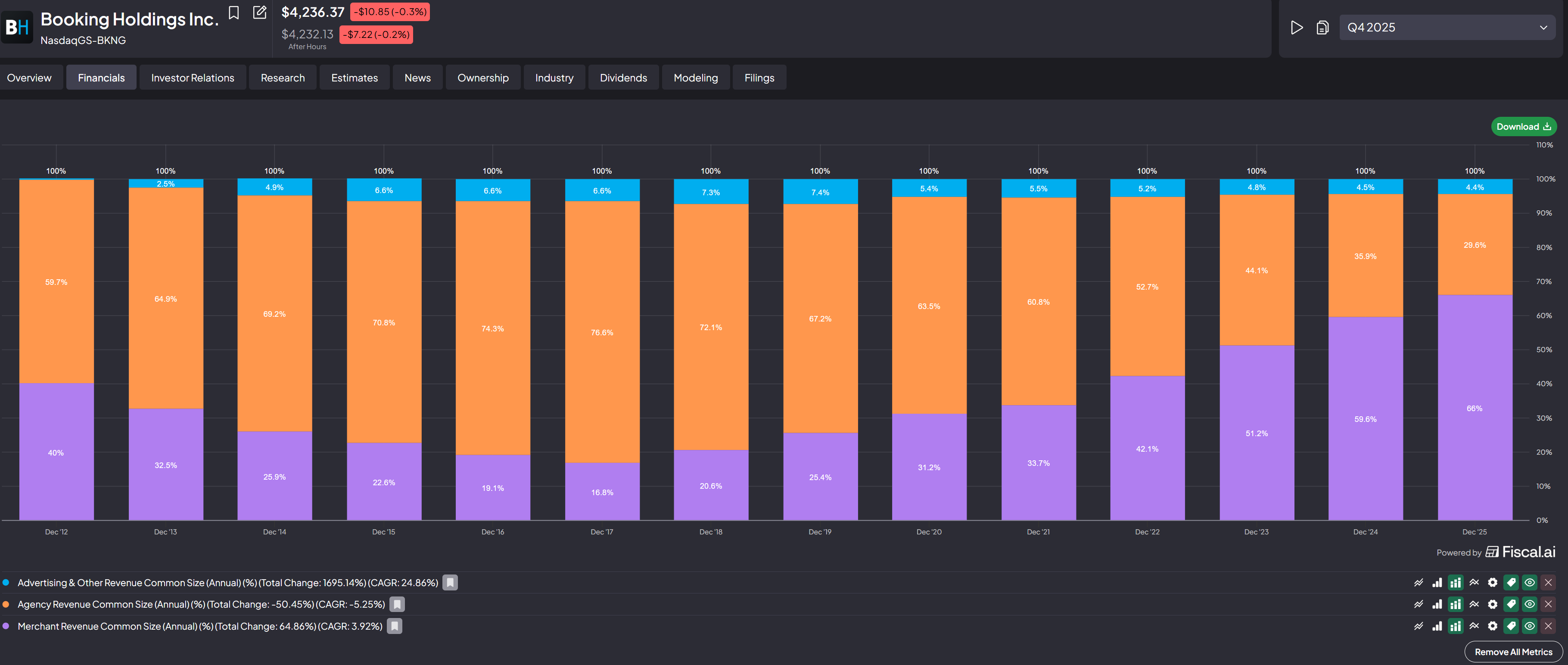
The simplest way to understand $BKNG's business model is by looking at their three revenue segments (see % breakdown chart below):
- Merchant Model Revenue
- Agency Model Revenue
- Advertising & Other
Agency Model (the origin story)
When Booking.com first launched, it operated purely as a middleman platform. Under the Agency model, Booking.com connects travelers to hotels but never touches the money. The guest pays the hotel directly (either at time of booking or at check-in), and after checkout, the hotel pays Booking.com an agreed commission, typically 15%.
This model was a key reason hotels loved Booking.com in the early days. Hotels maintained full control over pricing, kept the customer relationship, and had favorable cash flow since they received payment before remitting commission to Booking.com. The agency model was capital-light and low-risk since $BKNG never had to take on inventory or process payments.
Merchant Model (the evolution)
Over time, $BKNG has shifted towards the Merchant model (i.e. $BKNG is the "Merchant of Record"). Under this model, the guest pays Booking.com directly for the full price at the time of booking. After check-in, Booking.com remits the net amount (full price minus its commission) to the hotel.
Why the shift? Several reasons:
First, growth on the agency model had effectively plateaued. As $BKNG scaled, squeezing growth from a pure commission-referral model became increasingly difficult. Most new growth initiatives, whether loyalty programs, bundled trips, or dynamic packaging, required the ability to process payments and control pricing directly.
Second, the merchant model dramatically improves $BKNG's competitive positioning. When you control the transaction, you can,
- Own the customer
- Fund discounts out of your own margin to undercut hotels' direct channels
- Bundle hotels with flights and rental cars into packages
- Run loyalty programs (like Genius) independently of hotel partners
Third, there are cashflow advantages. Since $BKNG receives cash from the guest upfront and only remits this to the hotels later (less commissions) , $BKNG gets to hold cash for weeks or even months and is able to improve its cashflow position, and generate additional financial income in the interim.
Fourth, and often overlooked: competing with Airbnb requires the merchant model. Hotels have the infrastructure to process payments themselves. But private apartments, villas, and the long tail of alternative accommodations typically don't want to manage payment processing. If $BKNG wants to compete in the alternative accommodations space, it needs to handle payments on behalf of hosts. As of Q4 2025, Booking.com lists 8.6 million alternative accommodation properties, closing in on Airbnb's 9 million.
The shift from Agency to Merchant model is visible in chart above, where over the last 13 years, Agency revenues have dropped from 59.7% to 29.6% whereas Merchant model revenues have grown from 40% to 66%.
Advertising & Other
The smallest segment includes Kayak's metasearch advertising revenue (where travel providers bid for placement in search results), OpenTable's restaurant reservation fees (a mix of subscription fees and per-cover charges), and other offerings like travel insurance. It still remains a very small part of the overall business and its strategic importance is less about direct revenue contribution and more about its role in the "Connected Trip" vision, where $BKNG aims to own the entire travel experience from flight to hotel to restaurant to activity.
Geographic Mix: An European Company in American Clothing
One thing investors often misunderstand about $BKNG is where the business actually operates. Despite being a Connecticut-headquartered, NASDAQ-listed company, the vast majority (90%) of its revenues come from outside the United States.
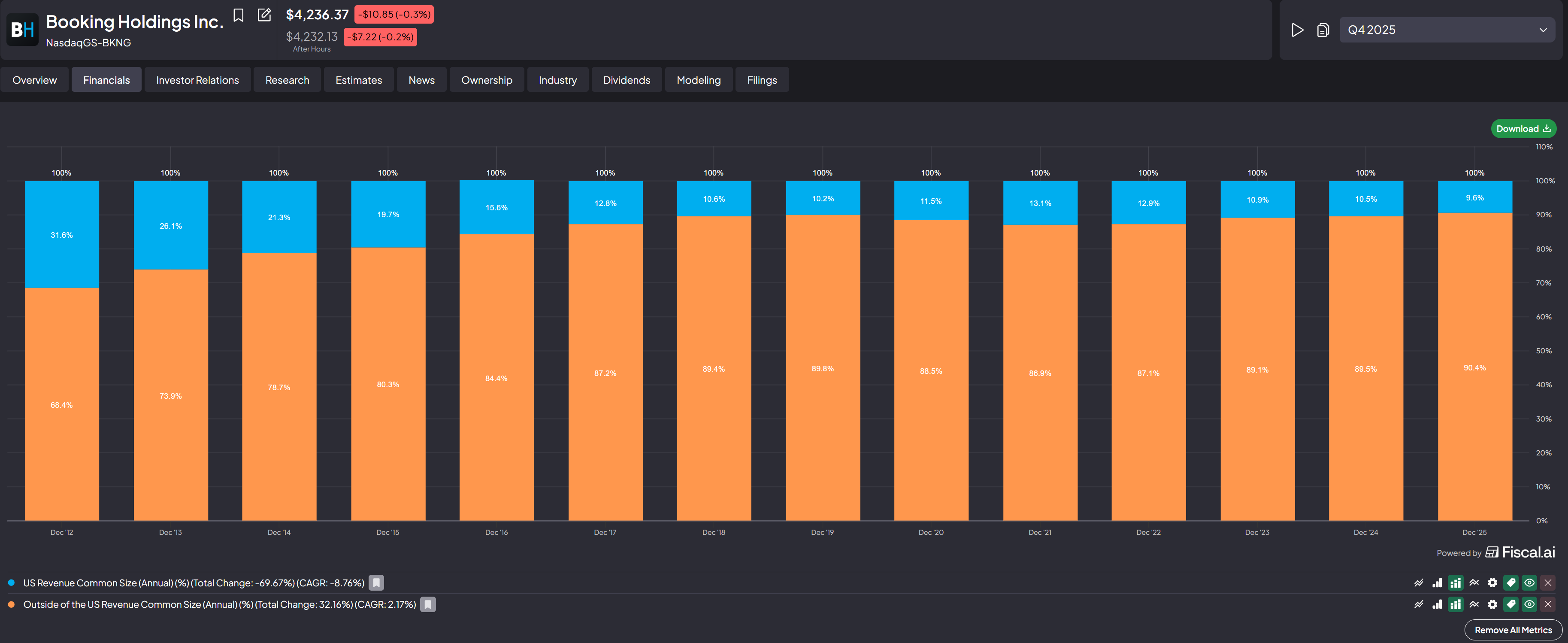
Europe is the company's largest market by far. $BKNG dominates the European OTA (Online Travel Agency) market in a way that has no real parallel in other regions. Europe also happens to be the world's largest international travel market, with dense cross-border travel flows (think a German booking a hotel in Spain, or a Brit visiting Italy) that play perfectly to an OTA's value proposition.
Asia is the fastest-growing region driven by Agoda, accounting for roughly 24% of room nights as of late 2024 and remains underpenetrated by OTAs relative to Europe.
A key reason $BKNG dominates both markets: roughly 77% of European hotels are independently owned, and globally outside the U.S., only about a third of hotels belong to a chain brand. Compare that to the U.S., where over 70% of hotel rooms belong to chain brands like Marriott, Hilton, and Hyatt.
Independent hotels lack their own global distribution and loyalty infrastructure, which makes them far more reliant on OTA aggregators like Booking.com for bookings. In the U.S., where chains dominate and travelers are funneled through powerful loyalty programs like Marriott Bonvoy and Hilton Honors, the OTA value proposition is structurally weaker.
This is precisely why the U.S. is $BKNG's smallest, slowest-growing and most competitive region. Americans tend to book through Expedia, Airbnb, or directly through hotel brand apps and loyalty programs.
The Travel Stack & AI Disruption?
The most common bear case against $BKNG right now is that AI agents will disintermediate OTAs. The logic goes: if a traveler can simply ask ChatGPT, Gemini, or Claude to "find me a family-friendly hotel in Tokyo under $300/night," why would they ever open Booking.com again?
It's a reasonable question but it reveals a misunderstanding of where $BKNG's value actually sits. The bear case treats Booking.com as a search engine for hotels. If that's all it were, then yes, AI would be an existential threat. But search is only one layer of what $BKNG does, and it's the layer where the least economic value is captured.
To see why, it helps to break down travel into its structural layers, what I'll call the "Travel Stack":
Layer 0: Supply Aggregation Get the inventory onto the platform.
Before anyone can search for a hotel, someone has to onboard that hotel into a bookable system in the first place. This is the foundational layer, and it's the one people most underestimate.
Booking.com has built three supply pipelines over 26 years:
- A self-service registration portal (join.booking.com) where any property owner can list
- API integrations with hundreds of channel managers and property management systems to list their properties
- Regional partner services teams embedded in local markets across 140+ offices globally to acquire and manage new accommodation listings
The result is 31M+ total listings across 220 countries.
But onboarding isn't just collecting property details. Every new listing goes through KYP (Know Your Partner) verification, which includes identity checks, business registration validation, and anti-money laundering compliance, all varying by country.
On top of that, $BKNG might even verify a new property's physical existence through mailed verification codes, manually reviewed walkthrough videos, or live video calls. For example, take a look at how detailed their video upload process is in the screenshot below:
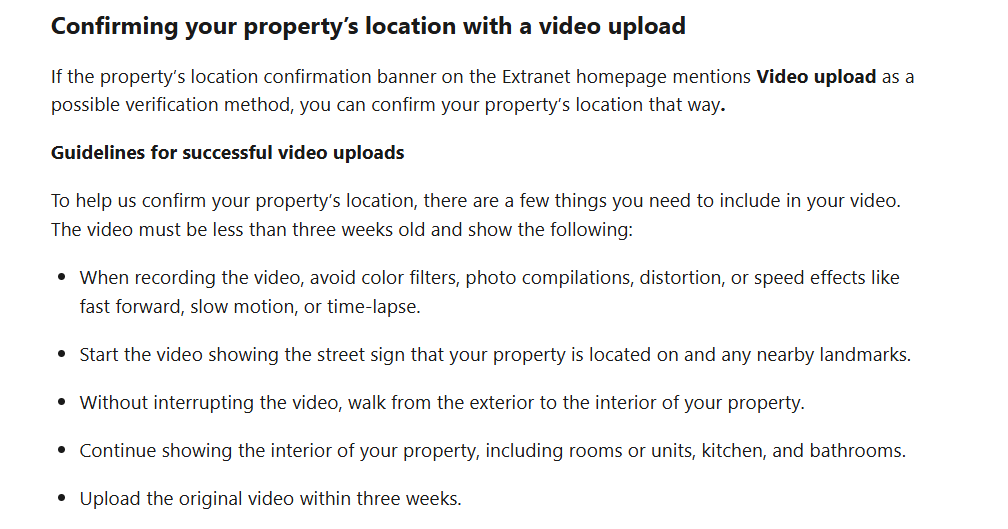
Unverified properties get closed and payouts blocked.
This is regulatory, operational, and physical infrastructure built one property at a time. I don't think the folks at OpenAI or Gemini have the bandwidth or interest to be vetting property listings!
Layer 1: Search & Selection Help me find and choose a hotel
This is the layer AI most likely 'disrupts'. Compressing hours of search and comparison into a single conversational query. But disrupting this layer isn't new. Google has owned the top of the travel discovery funnel for the past 20 years. When you search "hotels in Barcelona," Google shows you prices, ratings, photos, and maps before you even click through to an OTA like Booking.com.
There have been multiple examples of top-of-funnel players attempting to go down the funnel and take bookings directly:
- Google launched "Book on Google" in 2015, letting users complete the entire hotel reservation without leaving Google's interface. They pulled the plug in 2022.
- TripAdvisor released "Instant Booking" in 2014 to convert its massive review traffic into direct reservations. Conversion rates were so poor they quietly walked it back.
Both had the traffic and brand recognition but failed eventually. Why? Because going from "showing you hotels" to "actually processing your booking" requires an entirely different set of capabilities: payments, compliance, customer support, fraud prevention, and more. As I'll walk through in the layers below, this is exactly the infrastructure $BKNG has spent decades building, and it's exactly what discovery players like Google don't want to touch.
So they retreated to what they were good at. Google went back to selling ads to $BKNG, and $BKNG went back to spending roughly billions per year on marketing (a significant chunk of which flows to Google). The relationship became symbiotic, not competitive. Google monetizes discovery; $BKNG monetizes the transaction. Both have thrived.
AI is following the same structural path. And $BKNG isn't fighting it. Booking.com was one of OpenAI's launch partners for the ChatGPT Apps SDK in October 2025, feeding live inventory, pricing, and availability directly into ChatGPT. Think of it like the "hotels in Barcelona" example, but instead of Google showing you results, ChatGPT does in the chat window. Travelers browse listings within a ChatGPT conversation and then complete their booking on Booking.com's platform. The AI handles discovery and Booking handles everything after.
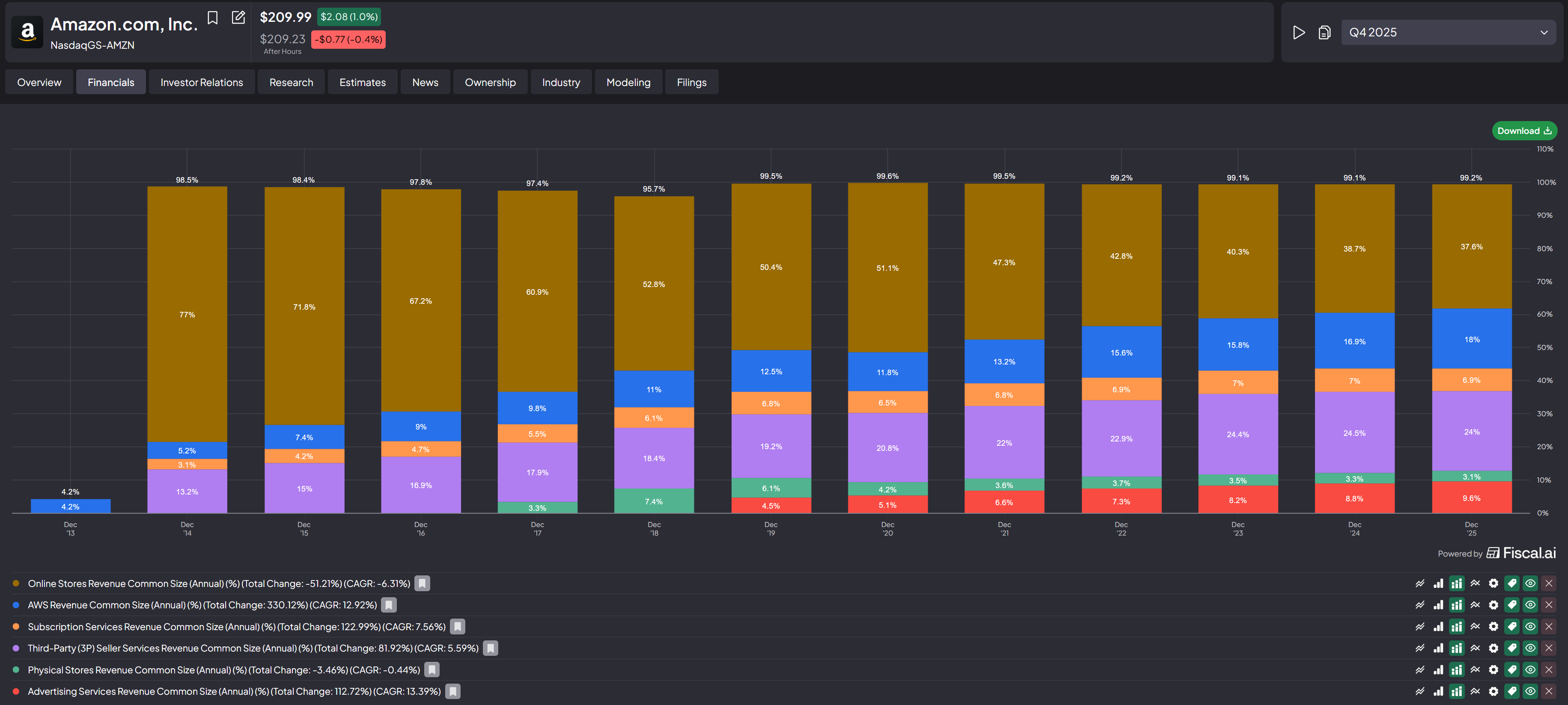
Why would $BKNG willingly hand over the discovery layer? Because they can afford to. $BKNG's Advertising and sponsored listings represent roughly 4-5% of total revenue. Compare that to Amazon, which blocked ChatGPT's crawlers because its far larger $68Bn+ advertising business (~10% of revenues) depends on human eyeballs seeing promoted products. AI agents bypass sponsored listings entirely, which is existential for ad-driven models but barely material for Booking.
For $BKNG, AI agents are simply a new source of demand that still flows through Booking's transactional infrastructure. If anything, they're a tailwind, not a threat.
Layer 2: Trust & Confidence Convince me to commit my money.
This is the layer where a traveler goes from "looks interesting" to "I'm comfortable spending $2,000 here". The biggest contributing factor? Verified reviews.
$BKNG is built on 360M+ verified reviews, each requiring a completed stay through the platform before a guest can leave feedback. You can't review a property on Booking unless you actually booked and stayed there. This is fundamentally different from Google Maps or TripAdvisor, where anyone can post a review without ever visiting.
AI can summarize reviews. It can't generate them. Every review in Booking's system requires a real person to book, stay, and write about their experience on a platform that confirmed they were actually there. As the platform where the booking actually occurs, $BKNG will always remain the primary source of truth.
Layer 3: Transaction Process my booking and take my money.
This is where the merchant model shift discussed earlier becomes strategically important beyond just revenue mix. Under the merchant model, $BKNG is the Merchant of Record: the entity that charges the customer's credit card, holds the funds, and bears the liability.
Even if a traveler discovers a hotel through ChatGPT, the moment they click "book," it's $BKNG that processes the payment across 100+ methods (credit cards, PayPal, Klarna, Alipay, local bank transfers), handles FX conversion across 50+ currencies, runs fraud checks, manages PSD2/SCA compliance in Europe, and calculates VAT by jurisdiction.
This is the same complexity that tripped up Google and TripAdvisor when they tried to move beyond discovery. It's capital-intensive, regulation-heavy, and operationally unforgiving. The margin structure of processing travel bookings (chargebacks, fraud, cancellations, split payments, cross-border compliance) is a world apart from just selling AI subscriptions or advertising. And AI companies already have their hands full burning cash on inference costs and GPU buildouts; taking on the operational burden of becoming a global travel payment processor is the last thing they need.
Layer 4: Fulfillment Take care of me before, during, and after my stay.
Modifications, cancellations, refunds, chargebacks, 24/7 multilingual customer support in 40+ languages, dispute resolution, rebooking when things go wrong at 2am in a foreign country. Under the merchant model, $BKNG owns this end-to-end because they hold the funds. A cancellation or chargeback flows through Booking, not the hotel.
This is operationally heavy, margin-thin work that AI companies have zero incentive to take on.
The Flywheel
These layers don't exist in isolation. Layer 4 (Fulfillment) feeds directly back into Layer 2 (Trust). Every completed stay generates a new verified review and every resolved dispute builds platform trust. This trust drives more bookings, which generates more fulfillment data, which deepens the review pool further. The loop compounds with every transaction.
And once a traveler has completed this journey multiple times, loyalty kicks in as the binding agent across all layers. $BKNG's Genius loyalty program rewards repeat bookers across three tiers with escalating benefits:
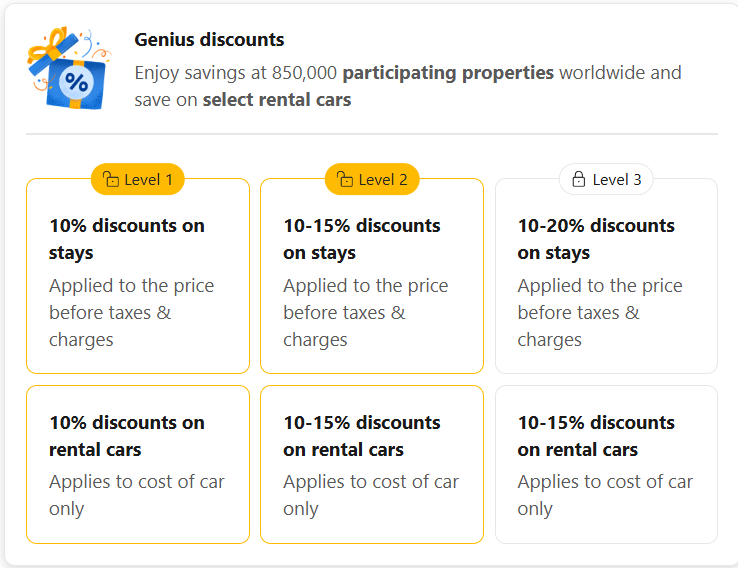
A Genius Level 3 member isn't going to abandon years of accumulated status to book through ChatGPT, where they'd start from scratch with no tier benefits, no priority support, and no earned discounts. The more a traveller uses Booking, the more expensive it becomes to leave. In this sense, the Genius program functions as a switching cost moat for existing customers.
And it's worth asking: is OpenAI or Google going to build a travel loyalty program? It's hard to imagine. Loyalty programs require merchant-of-record status, direct supplier relationships, and the ability to fund benefits like room upgrades and free breakfasts. That's a travel operations business, not a language model business.
My Next Investment Steps & Valuation buy levels:
Note: The following does not constitute financial advice/recommendation and is merely a journal of my own portfolio investment actions.
Given the above analysis of how AI is likely a tailwind (as an extra discovery/recommendation channel) rather than a headwind for $BKNG, I'm confident the company will not be disintermediated and I view the recent ~30% drawdown from the 52-week high as unjustified pessimism driven by AI fears.
My next investment steps and valuation buy levels are as follows:
With $BKNG, I'm approaching this very differently, with more care, by...
(🔒Unlock below with premium tier):